Architecture
Seahorse enforces a benchmark contract that separates what the framework controls from what each model family controls. This page explains that separation so you know where to look when adding a model, debugging a run, or interpreting results.
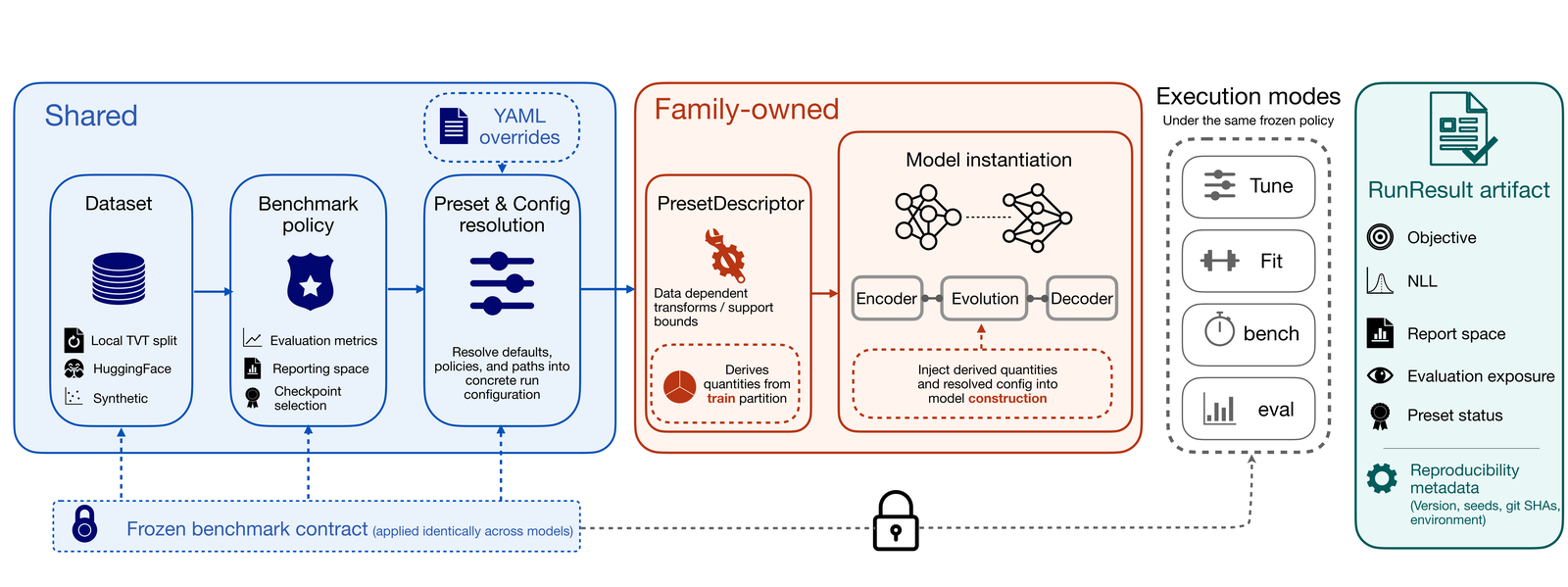
Figure 3 from the Seahorse paper: the execution contract. Shared components are framework-owned (left). Family-owned components control data-dependent transforms and model construction (centre). All four execution modes write a RunResult artifact (right).
Shared Layer
The shared layer runs identically for every model family. It fixes the benchmark before any model-specific code executes.
| Component | Module | Responsibility |
|---|---|---|
| Dataset | training/data_module.py |
Load local or HuggingFace JSONL splits; apply protocol and normalize settings |
| Benchmark policy | benchmark/benchmark.py |
Force protocol="unified" and a single normalize value across all presets; prevent re-splitting or per-model coordinate changes |
| Config resolution | config/schema.py |
Merge YAML defaults → preset defaults → CLI --override into a STPPConfig (validated Pydantic v2) |
| Training harness | training/lightning_module.py |
Per-event NLL aggregation, checkpointing, early stopping — same for all families |
STPPConfig has four sub-configs: DataConfig, ModelConfig, TrainingConfig, LoggingConfig. The resolved config is serialised with the run and is the source of truth for what was actually trained.
Why the shared layer matters for comparisons
Benchmark NLL values are only directly comparable when all presets are evaluated under the same dataset, normalization, and metric definition. The shared layer enforces this — no preset can silently change the coordinate system or re-split the data during a benchmark run.
Family-Owned Layer
Each model family registers a config class (a BaseModelConfig subclass under seahorse/models/configs/) with ConfigRegistry. This is where family-specific behaviour lives.
Preset registry
# seahorse/models/configs/base.py
@ConfigRegistry.register("auto_stpp")          # preset name → config class
class AutoSTPPConfig(BaseModelConfig): ...

ConfigRegistry.register_alias("neural_stpp_gmm", "njsde")   # accepted alias
ConfigRegistry.describe("njsde")               # PresetDescriptor: name, status, config class
build_model(config, preset, ...) merges resolved defaults, looks up the config class, calls from_dict(), then calls build_model() on the resulting config object. No assembly logic lives in the registry itself.
Data-dependent initialisation
Config classes may override the classmethod data_init_overrides(dm); the runner calls ConfigRegistry.data_init_overrides(preset, dm) before build_model():
- it computes training-data-dependent quantities (e.g., the bounding box for
auto_stpp, support statistics fornsmpp, float64 / MPS fallback for the Neural-STPP ODE solver), together with any fitted coordinate transform (fit_transform_artifact); - the result is merged into
build_overridesand passed to the config class'sfrom_dict().
This is the only point where training-data statistics can enter model construction — they are computed from the training partition only and are never derived from validation or test data.
ModelFamilyConfig pattern
Each family config is a dataclass with two required methods:
@dataclass
class MyFamilyConfig(BaseModelConfig):
    @classmethod
    def from_dict(cls, merged_dict, *, hidden_dim, spatial_dim, ...) -> "MyFamilyConfig":
        ...  # instantiate from already-merged dict

    def build_model(self) -> UnifiedSTPP:
        ...  # return fully wired model, no arguments
Existing families: DeepSTPPConfig, AutoSTPPConfig, NeuralSTPPConfig, SMASHConfig.
Model Layer
Every model is a UnifiedSTPP(state_model, event_model, *, hidden_dim). The three-component decomposition from the paper maps directly to the code:
| Paper component | Code role | Examples |
|---|---|---|
| History encoder | StateModel owns self.encoder |
TransformerEncoder, TransformerST |
| State evolution | StateModel.evolve() — piecewise-constant or ODE |
JumpOdeIntensityProcess (neural ODE + Euler solver) |
| Decoder / event law | EventModel owns spatial and temporal decoders |
MonotoneIntegralDecoder, HawkesGaussianDecoder, JumpCNFSpatial |
The EventModel.log_prob() return value determines both the training objective and the available evaluation queries. Families that return a point-process log-likelihood (closed form, ODE-integrated, or with a numerically integrated compensator) support the exact NLL metrics; families that train on a surrogate objective (SMASH: score matching; DSTPP: a diffusion objective) only report a sample-based NLL estimate.
Exact vs approximate NLL
SMASH and DiffusionSTPP optimise surrogate objectives; their benchmark test_nll is a sample-KDE estimate, not a likelihood bound, and is not directly comparable to exact-NLL families. The Model Capability Matrix flags this.
Execution Modes
All modes go through the same shared layer, then differ in what they do with the model and outputs.
| Mode | Entry point | What it does |
|---|---|---|
fit |
runner/runner.py → STPPRunner.fit() |
Train one config, checkpoint, write RunResult |
tune |
benchmark/hpo.py |
Wrap fit in a Ray Tune loop; write {preset}_best.yaml |
bench |
benchmark/benchmark.py → Benchmark.run() |
Grid over presets × datasets × seeds; apply benchmark policy; collect RunResult objects |
evaluate |
cli/ evaluate subcommand |
Load a saved run directory; compute metric profiles and visual artifacts |
campaign |
cli/ campaign subcommand → seahorse/experiments/ |
Compile a frozen manifest from a spec; verify, run, evaluate, calibrate and report its cells (optionally via Slurm) |
bench calls _apply_data_contract() in both tune_all() and run(), which forces protocol="unified" and a single normalize setting on every config. This runs before any preset-specific code, so no preset can silently change the benchmark policy.
Artifact Layer
Every fit, tune, and bench cell writes a RunResult artifact under the output directory.
@dataclass
class RunResult:
    val_nll: float          # per-event NLL in training coordinate space
    test_nll: float
    norm_stats: dict        # {normalize, time_mean, time_std, loc_mean, loc_std}
    config: STPPConfig      # resolved config used for this run
    ...
| Artifact | Location | Contents |
|---|---|---|
run_result.json |
run dir | RunResult fields including norm stats |
config.yaml |
run dir | Resolved STPPConfig (what was actually trained) |
checkpoint.ckpt |
run dir | PyTorch Lightning checkpoint |
metrics.json |
evaluate output | Per-metric results, availability, and reason if unavailable |
bench_meta.json |
bench dir | Benchmark configuration and provenance |
cell_index.json |
bench dir | Maps (preset, dataset, seed) to run directories |
norm_stats is required to convert normalised NLL back to original-coordinate NLL:
Quick Reference: Where to Look
| Question | Where to look |
|---|---|
| Why did my run use different normalization than expected? | run_result.json → norm_stats; check DataConfig.normalize |
| How do I add a new model? | Adding A Model — start with ModelFamilyConfig |
Why is my model's NLL not comparable to auto_stpp? |
Check EventModel.log_prob() — is it exact or surrogate? |
Why does bench override my preset's normalize setting? |
Benchmark._apply_data_contract() — this is intentional |
| Where is the resolved YAML for a run? | {run_dir}/config.yaml |