Seahorse
A benchmark and library for spatio-temporal point processes:
13 datasets, 28 model presets, one evaluation protocol with exact likelihoods and calibration.
Seahorse couples declarative YAML configuration with PyTorch Lightning execution, Ray Tune hyper-parameter optimisation, and versioned run artifacts for reproducible benchmarking of event data. The Seahorse paper is accepted at NeurIPS 2026 (Track on Evaluations and Datasets); see Cite Seahorse.
model.fit(train, val, test)
Fit, evaluate, and sample from any registered model through a consistent Python API.
Python API
Run a Benchmark
python -m seahorse bench
Compare presets across datasets and seeds from one CLI command with saved, reproducible artifacts.
Run a Benchmark
Evaluate Results
model.evaluate(test)
Run metric profiles — likelihood, predictive, surface — on any saved run directory.
Evaluation Guide
Add Your Model
@ConfigRegistry.register(...)
Register a preset and your model works with fit, bench, and the metric profiles without changing import paths.
Developer Guide
What Seahorse Provides
| Capability | What it gives you |
|---|---|
| Unified Python API | Train, evaluate, and sample any supported model through one interface. |
| YAML-driven experiments | Keep hyperparameters, data paths, and run settings explicit and reproducible. |
| Model presets | Switch among AutoSTPP, DeepSTPP, neural CNF families, diffusion models, NSMPP, SMASH, THP, RMTPP, and parametric baselines. |
| Benchmark campaigns | Run multi-preset, multi-dataset, multi-seed evaluations with comparable metrics. |
| Artifact-backed evaluation | Save run directories, metric tables, predictive samples, and surface diagnostics for later inspection. |
Quick Start
from seahorse import AutoSTPP, PoissonGMM, load_jsonl

train = load_jsonl("dataset_root/train.jsonl")
val   = load_jsonl("dataset_root/val.jsonl")
test  = load_jsonl("dataset_root/test.jsonl")

model    = AutoSTPP(device="cpu")
baseline = PoissonGMM()

model.fit(train, val, test, epochs=50, batch_size=64)
scores  = model.evaluate(test)
samples = model.predict_next(test, n_samples=32)
Benchmarking Workflow
Seahorse reads JSONL event-sequence splits from local files or compatible Hugging Face datasets. Every benchmark run applies a shared data contract so models are evaluated on the same train, validation, and test splits with the same metric definitions.
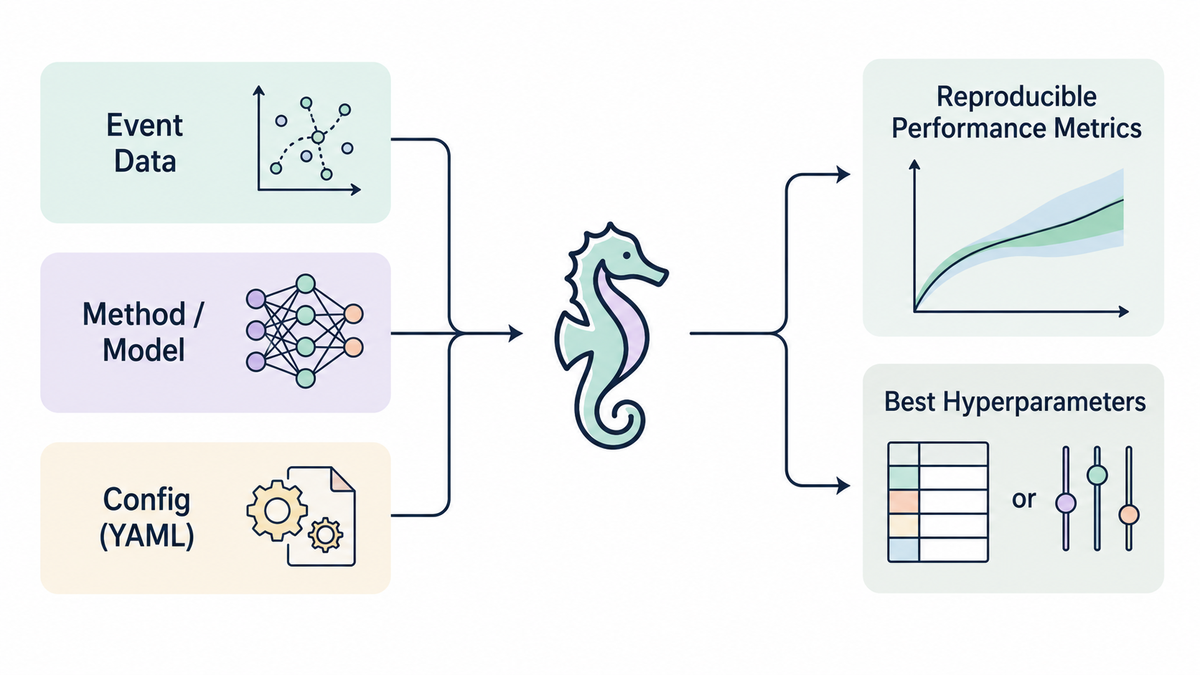
Start with the end-to-end case study, run a small benchmark, or open the tutorial notebooks.